Many people experience a hernia, where an organ or tissue protrudes through an opening within the abdominal region because of its weak point there. It presents itself as a swelling or bulge within or near the groin, where there could be pain and discomfort, especially while lifting or standing.
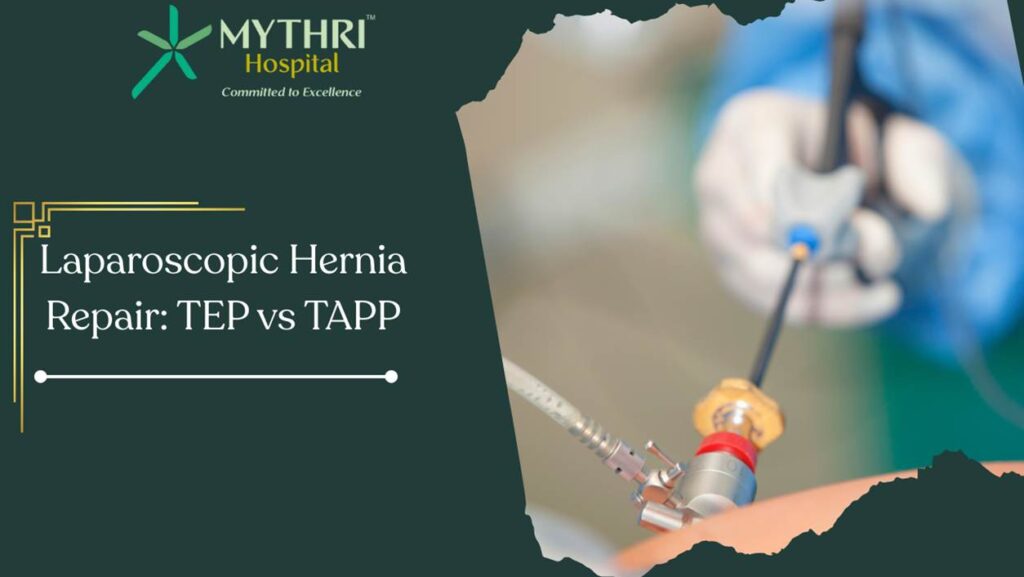
Through advancements in medical technology, laparoscopic hernia mesh repair became an attractive alternative. It involves making few incisions, using a camera, as well as surgical tools, to properly mend the hernia with reduced pain and quick recovery. The most favored alternatives among the laparoscopic hernia repairs include TEP and TAPP. These procedures involve fixing the same issue but slightly differently.
What Is Laparoscopic Hernia Repair?
In laparoscopic hernia repair, there are smaller incisions, unlike in open hernia repair. However, in laparoscopic hernia repair, a mesh is used to cover up weak spots where the hernia occurred in order to prevent its reappearance in the future by ensuring that the wall of the abdomen is strong. In laparoscopic hernia repair, there is reduced pain as well as faster recovery.
How Is TEP (Totally Extra peritoneal Repair)?
With the TEP method, the surgeon fixes the hernia without going through the abdominal cavity. The procedure takes place in the area between the abdominal muscles and the inner wall of the abdominal cavity.
Small incisions are made below the belly button, and tools are used carefully to make room for repairs. The hernia is placed back into position, and a mesh is used to fortify the patch. Since there are no openings made inside the abdominal cavity, organs are left undisturbed.
Advantages of TEP
- Reduced risk of injury to internal organs
- Reduced risk of complication involving bowels
- Lower risk of internal adhesions
- Fast recovery by experienced professionals
Limitations of TEP
- Technically more challenging
- Needs a skilled laparoscopic surgeon
- Small working space
- May not be appropriate for patients who have had previous lower abdominal surgeries
What Is TAPP (Transabdominal Preperitone)
In the TAPP method, the surgery begins with the incision into the abdominal cavity, followed by access to the hernia area from inside.
Small cuts are made in the abdomen, and with the help of a camera, the surgeon can easily view the hernia. The lining of the abdomen is then opened, and the hernia is repaired. A mesh is placed over this weak spot. The abdomen is then closed with this mesh inside.
Advantages of TAPP
- A better visualization of internal body parts
- Less invasive to do, especially with complex hernias
- Helpful for Recurrent & Bilateral Hernias
- Applicable for patients with past lower abdominal surgery
Limitations of TAPP
- Invasion into the abdominal cavity is likely to affect internal organs
- Chance of internal adhesions slightly increased
- It requires meticulous closure of the abdominal lining
Which Approach Is Better?
There isn’t any particular method that would be best suited for every patient. Both TEP and TAPP are safe and effective in the hands of a skilled surgeon. Moreover, the selection of the method can be influenced by the following factors:
- Type and size of the hernia
- Whether the hernia is on one side or on both
- The patient’s surgical history
- Surgeon’s expertise and comfort with technique
With experienced practitioners, both procedures are highly successful with low rates of recurrence.
Recovery After Surgery
- Return home on the same day or within 24 hours
- Resume light activities within a few days
- Resume normal activities in one to two weeks
The pain could be handled with medicines, though lifting heavy would be avoided for a couple of weeks as recommended by the doctor.
Possible Risks
Laparoscopic hernia repair is quite safe, but like all other surgeries, there are some risks associated with this procedure too. These risks may include pain, swelling, infection, bleeding, or discomfort caused by the mesh used during this surgery. The recurrence of hernia is quite rare if this surgery is performed properly.
CONCLUSION
Both TEP and TAPP are relatively new laparoscopic methods for hernia repair. TEP requires that no incision be made in the abdominal cavity, whereas TAPP allows more visibility. Both are ideal based on the requirements of the patient’s health as well as the preference of the surgeon. If you have been diagnosed with a hernia, you should seek the advice of a qualified laparoscopic surgeon as to what will be most beneficial in your personal circumstances.